Day Two of the Writing Challenge – so how is it going so far? Are you wondering how to fit it in and maintain dedicated space for writing in your week? This is familiar problem for many academic writers. Identifying and developing a writing habit that will work for you and sustain your productivity can be an ongoing challenge, but time invested in exploring what works for you will be well worth it.
Today’s guest Writing Challenge blogger is Karina Quinn, a postgraduate student in the School of English. She was the winner of both the Peoples’ Choice and Faculty award at La Trobe University’s 2012 Three Minute Thesis competition and is also one of the founders and Managing Editors of Writing from Below, a peer reviewed, open access interdisciplinary Gender, Sexuality and Diversity Studies journal.
In her piece, Karina examines her evolving approach to writing as she has progressed through her PhD candidature. As she highlights, embarking upon a substantial research project often necessitates the re-evaluation of one’s writing processes and systems of self-organization. Sporadic writing ‘binges’, which were effective when approaching more contained writing projects, may not provide sufficient fodder to maintain a sense of control over a large thesis. The ‘pomodoro technique’ has gained increasing currency amongst academic writers because it can help to enhance focus and determination and to avoid distractions, thus, aiding writers to navigate away from the downward spiral of guilt and anxiety that often accompanies procrastination. Using this method, as well as attending regular group writing sessions, has enabled Karina to make significant and impressive inroads into her PhD thesis.

In praise of snack writing, the pomodoro technique, and productivity
When I started my PhD in 2011, I couldn’t call myself a writer without feeling like a fraud. The word ‘writer’ conjured up for me incredibly productive and slightly crazed individuals who sat at their desks into the small hours of the morning (or else got up at 3am every day, a-la Sylvia Plath, to write before the children woke) tapping away at keyboards and drinking litres of tea.
That was not me.
I was a binge writer (thank you, Thinkwell for this term). I would push something out, with pain, if there was an encroaching deadline or a course requirement hanging over my head, but that was all. I knew I should have a daily writing practice, but like eating four to five serves of vegetables a day or going to the gym three times a week, this stayed resolutely on my should do list.
Then I started a PhD in the English department at La Trobe. And suddenly I had to be able to sustain a long term writing project. Spewing something onto the page the night before was not going to work, but I also had no idea what would work. Enter Thinkwell’s workshop ‘the seven secrets of highly successful PhD students’. Needless to say, I was suspicious. It sounded far too chirpy for my liking. But I went. And that’s where I learnt about snack writing: doing a little bit of writing, often. I realised that if I wrote 1,000 words a week I’d have more than enough for a PhD. Then I learnt about golden hours: making an inviolable space for writing, every day. I did this in the beginning, and am glad I tried it, but it didn’t quite work for me. Sometimes I needed to read to be able to write, and I’ve needed some flexibility with that.
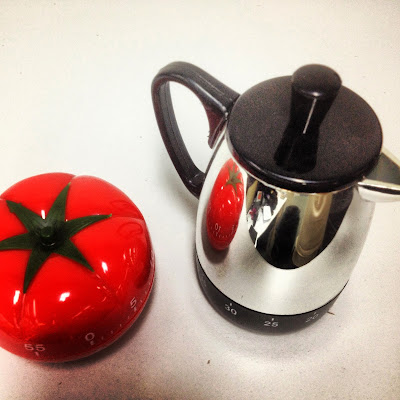
Which brings me to the pomodoro technique (essentially working in 25 minute blocks with five minute breaks after each block, and stringing these blocks together). I’d been following The Thesis Whisperer and taking her advice for some time when I read her post about Shut up and Write (and wow am I glad I did). I started reading and researching through the week, and then going to a Shut up and Write session at RMIT every Friday morning, where I was able to write 1,000 to 1,500 words in three pomodoroes. And there’s my weekly target. The benefits were instant and long lasting: psychological calm because I was producing good work, never needing to worry about supervision because I always had material to send her, and connection with and support from other post graduates and academics in a casual and friendly environment.
I’m now nearing the end of my second year and I have 65,000 words of my thesis written, and have published four papers (as well as some poetry and short stories), two of which are peer reviewed. If you’d told me I’d be in this position when I started, I wouldn’t have believed you. I thought I would be blocked and in pain with my writing forever (dramatic, but true). Making connections with other postgraduates and academics, and using the pomodoro technique to snack instead of binge are the keys to my productivity. I am one very happy and grateful writer. And yes, I now call myself a writer.
We hope Karina’s piece will inspire you to experiment with the ‘pomodoro technique’. You might like to come along to RED Writing ‘Hood ‘Shut Up and Write’, a weekly group writing session where the ‘pomodoro technique’ is used. ‘Shut Up and Write’ is held on the Bendigo campus on Wednesdays from 10-12 in HHS2 331 and 332, at Bundoora on Thursdays from 9:30am–noon in the Charles La Trobe Lounge and at Albury Wodonga on Thursdays from 9:30–noon in the Conference Room and Fridays from 9:30–noon next to the Library Training Room. All the details you need are available on the RED Unit website: http://www.latrobe.edu.au/research/red
Also, for all those interested, ‘Writing from Below’, will be officially launched on Friday, December 13th, 2013 at 7:30pm at Hare Hole at Hares Hyenas in Fitzroy. Check out the Writing from Below website for more information: http://www.lib.latrobe.edu.au/ojs/index.php/wfb/
And remember to keep us up-to-date with your Writing Challenge progress or your thoughts on the ‘pomodoro technique’ by posting in the comments section below. Happy writing!
Keep up to date
Find out more about Research Education and Development at La Trobe.