Writing a publishable literature review – #LTUacwrimo (Erika Duan, LIMS)
 |
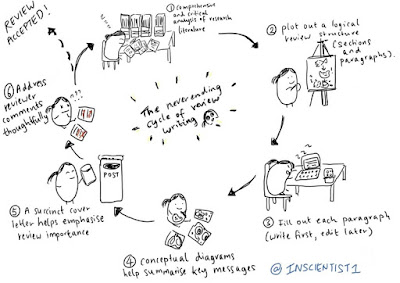
| Doodle of the academic writing and submission process (Erika Duan) |
Writing and publishing a literature review often seems like the work of established researchers who are leaders in their field, yet this is not always the case.
In this week’s blog, Erika Duan from LIMS advocates for PhD students and early career researchers to seek review writing opportunities.
Remember to check out the other activities we have organised, and follow along on Twitter by using the hashtag #LTUacwrimo!
—————————————-
More than just a CV-filler, having a published literature review can help reinforce your research expertise or even convey critical analysis skills to future employers. While high impact factor journals prioritise invited reviews from established or recently published researchers, there are still viable avenues to explore when aiming for a review publication.
1. Scope out the journals
When I was a PhD student, I actively dreamed about the day I would write a published review. Since I was studying lung macrophages in a laboratory that specialised in B cell research, that dream never came to be while I was still a student. I was able to write and publish in other ways though, and having these first author PhD publications helped when my post-doctorate supervisor and I discussed the possibility of publishing a review. Although I was now researching lung macrophages in a T cell laboratory, these publications helped highlight our prior research expertise. We sent expressions of interest to two specialised journals, with impact factors of 7 and 5 respectively, were rejected by one and received conditional interest from the other.
Our bottleneck was actually finding a well-regarded journal which was still open to accepting uninvited literature reviews. Here, my advice would be to familiarise yourself with your field’s journal hierarchy. A quick google search can provide you with an approximate rankings list. Pay particular attention to the more specialised but well-regarded journals (i.e. ones you would read and trust) in your field and send a few expressions of interest regarding the possibility of a review submission. A well-written letter may help tip the scale in your favour. This should be short and succinct, summarise the intention and content of your proposed review and list your recent publications relevant to the field. Teaming up with senior researchers is helpful (or even necessary) if a journal requires you to list a minimal number of relevant publications that is difficult to meet.
2. Read comprehensively and let thoughts settle
3. Shut up and write (SUAW
Beware the tyranny of the perfect sentence. Rather than aiming for organically flawless sentences, I have found that assigning paragraphs with key citations and then forcing myself to fill them with content has actually been my most effective writing approach. This approach can be easily fitted to SUAW sessions held by the La Trobe University RED unit, which are introduced in earlier blogs here and here. The first revision begins after the crude creation of my Frankenstein draft, which is then mended multiple times before it is sent off to my supervisor and other authors in a more presentable form.
My tip here is to try and embrace these draft revisions like an old friend. Yes, the process may feel like being stuck in a hopeless time vortex, but each revision should lead to a slight improvement on the old. This applies especially to your last revision, which is actually the post-acceptance manuscript proof.
5. Addressing reviewer comments
Unlike a research manuscript, where one may be at the mercy of unfeasible experiment requests, comments from the reviewers can be regarded as an external source of feedback suggesting further improvements. From experience, such comments have helped identify gaps in my literature reading or reminded me to clarify the scientific consensus in areas with more conflicting results.
Overall, opportunities for review publications more commonly present as invitations to pre-established research scientists. However, PhD students and junior scientists with a comprehensive and up-to-date knowledge of their research fields should feel encouraged to actively consider and seek review writing opportunities.
Like other parts of the research process, persistence and multiple revisions will play a part in eventual success.
———————————————–

Keep up to date
Find out more about Research Education and Development at La Trobe.